

Introduction
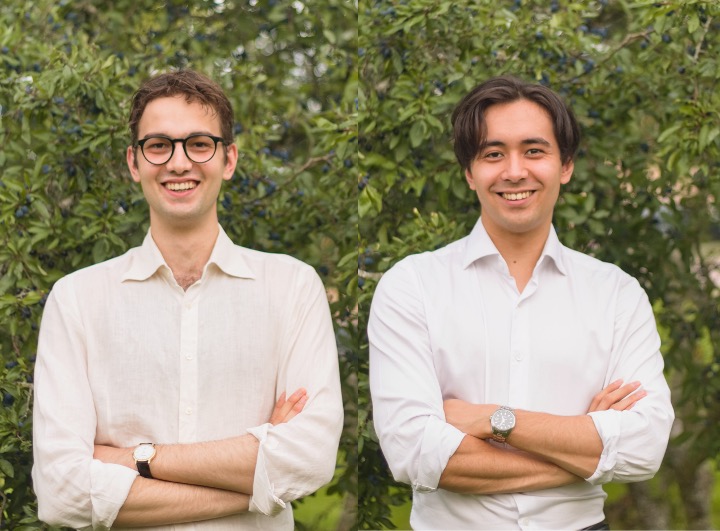
In the growing landscape of Japanese innovation, Sendai is emerging as an unexpected home for global founders working on technology with social impact. Among them are Kendal Fritzell and Hans Birkedal from Sweden, co-founders of RexTec. RexTec is a startup developing an AI-driven screening tool for gaming and internet disorder which is an issue affecting an estimated 2.4 million people in Japan. With roots in Tohoku University and deep ties to Sendai’s community, the founders are working to redefine early detection and prevention of gaming disorder.
Two Paths to Japan, One Vision
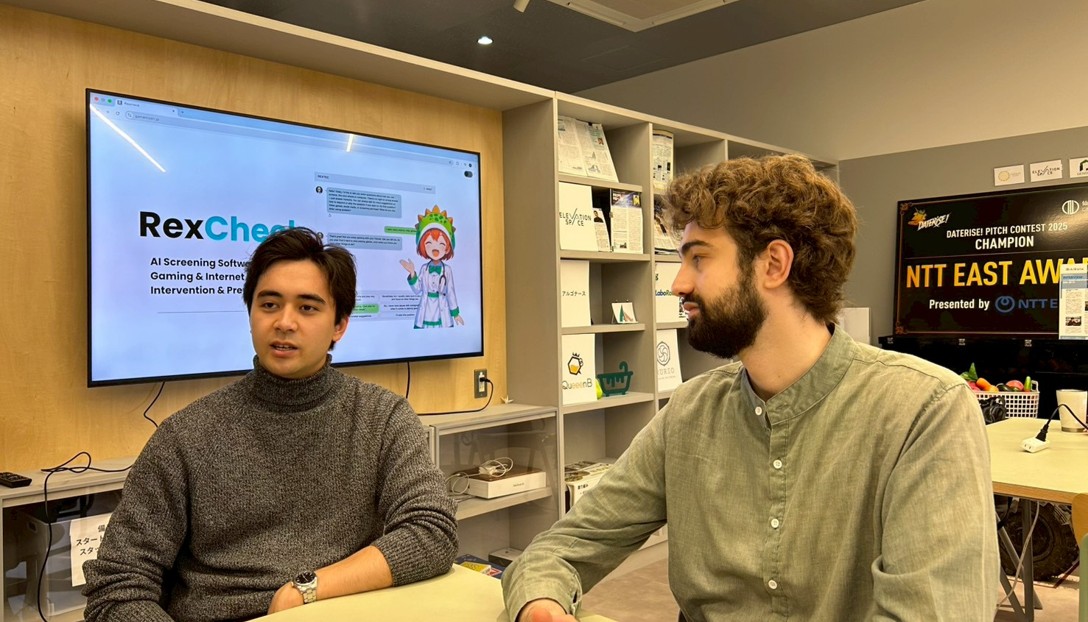
Kendal and Hans come from different backgrounds, yet their paths converged around a shared concern for how technology shapes human behavior. The two first met while studying engineering and languages at Linköping University in Sweden. They worked together in an international student association that supported East Asian exchange students. It was during this time that they discovered their shared interest in helping people affected by addictive technologies.
Kendal first came to Sendai as an exchange student at Tohoku University, drawn by the combination of nature and a highly respected engineering faculty. “Sendai reminded me of Sweden,” he recalls. “It has nature, space, and a balance that just felt right. Yet it still has the academic depth and opportunities you expect from a major city.” Hans, on the other hand, arrived in Japan through a different route and studied engineering at Kyoto University and later worked in machine learning and autonomous systems at Toyota Material Handling. Although he initially had no personal connection to Sendai, his perspective quickly changed after meeting Kendal’s contacts in the city and learning about its startup ecosystem.
Both founders share personal experiences with technology addiction, which deeply shaped their values and mission. “We bonded over our past struggles,” Kendal says. “We realized we both want to build technology that supports people and accelerates human potential, instead of diminishing it.” This philosophy inspired their company name: RexTec, short for Re-Excel Technologies, a belief that society can move forward again through humane, purpose-driven innovation.
A Hidden Epidemic in Japan
Gaming and internet addiction, classified by WHO as “gaming disorder”, has become a growing crisis in Japan. The country has seen a rapid rise in cases, especially among teenagers. One of the biggest facilities treating gaming disorder in Miyagi Prefecture saw the number of young patients increase from just 2 cases in 2020 to 79 cases by 2025, a nearly 40-fold increase in four years.
Despite this, over 99% of affected individuals never receive treatment. This “treatment gap,” as the founders explain, is caused by three main issues:
1.Lack of early screening tools suitable for children
2.High cost and time required for diagnosis
3.Low public awareness, where many affected youths do not realize they have a problem
At the same time, the consequences are severe: isolation, school absenteeism, and in worst case, suicide.
Kendal observed this firsthand while living in Japan. “On the subway, in cafes, in schools. You see how deeply screens are embedded in people’s lives. The dependency is visible everywhere.” Hans adds, “This issue is not only medical. It’s cultural, environmental, and psychological. There’s a huge need for early, accessible tools that help young people understand their situation before it escalates.”
RexCheck: AI with Empathy
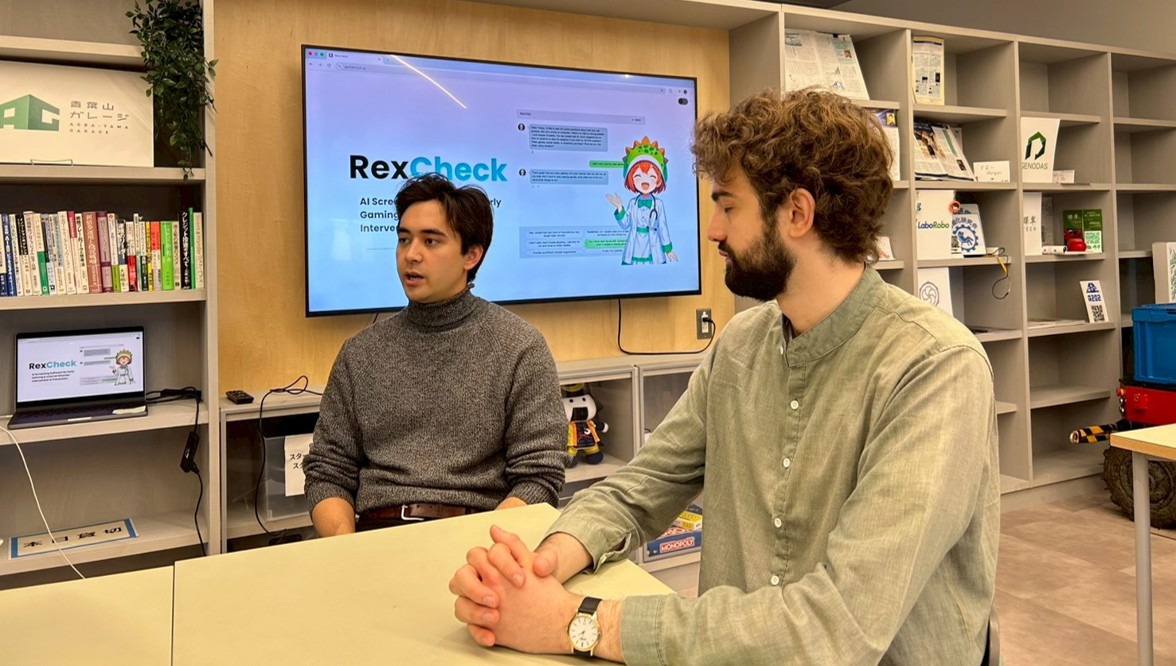
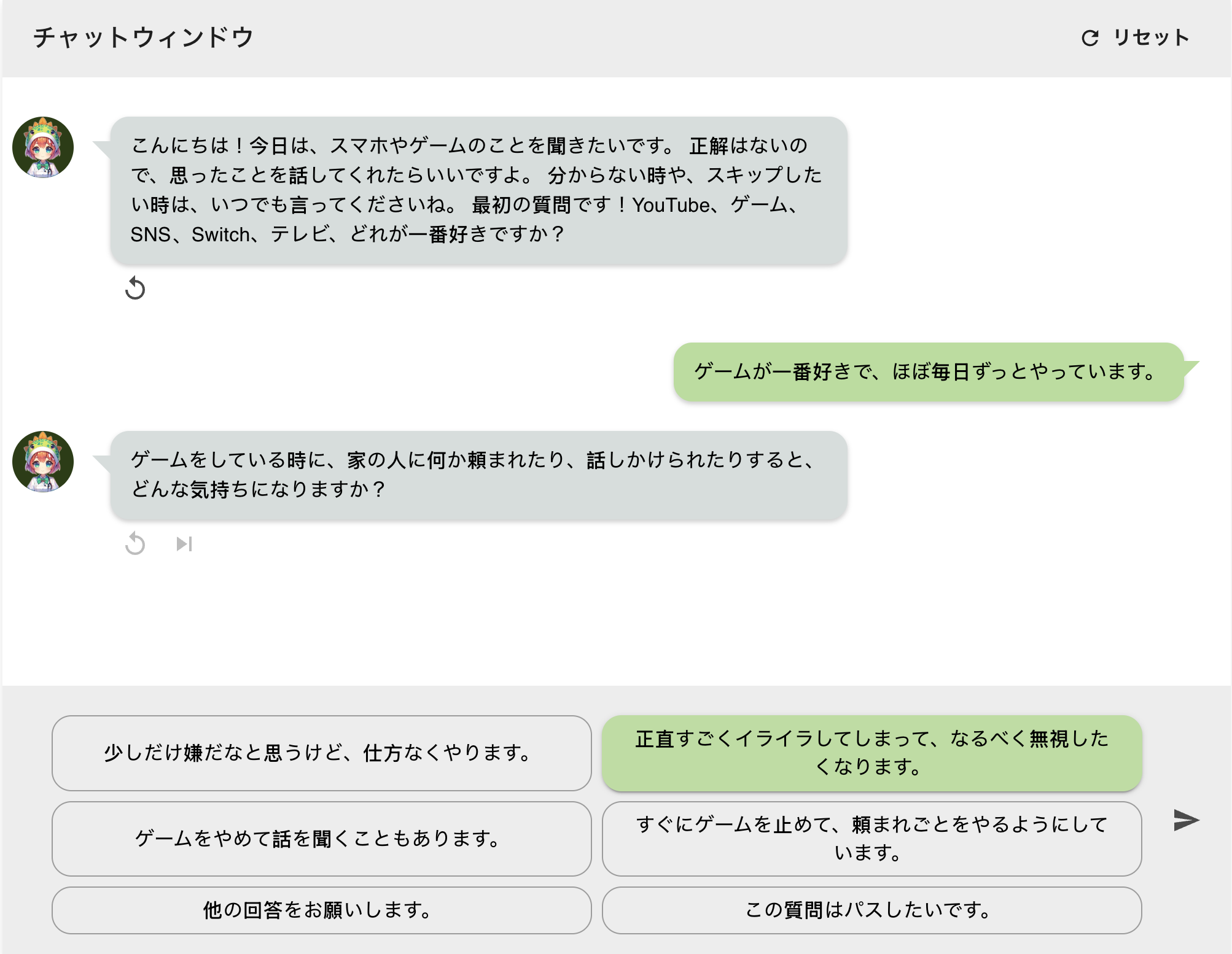
In response, the founders created RexCheck, an AI-based screening tool designed to identify gaming disorder or the risk thereof among children. Instead of traditional checkboxes and fixed questionnaires, RexCheck offers a guided, personalized chat-like interaction to each user.
The technology combines Large Language Models (LLMs) for generating adaptive questions, expert knowledge from clinicians and researchers, child-friendly interaction design, dynamic question paths, allowing each conversation to be unique, and AI-based scoring and risk analysis. Unlike a typical chatbot, RexCheck operates within a controlled “safe” screening flow, ensuring reliability and clinical relevance. “It’s not free chat,” Hans explains. “It’s structured, but dynamic. The AI adapts to how the child responds, just like a clinician would.”
One of their clinical partners is Tohoku Kai Hospital, a major treatment center in Miyagi. Through different collaborations, the team gained deep insights into real therapy processes and diagnostic methods. RexCheck currently focuses exclusively on gaming disorder, but is designed for future expansion into early intervention and prevention. “Screening is just the first touchpoint,” Kendal explains. “We want a full pipeline that supports students, parents, and schools.”
Why Sendai? Connections, Culture, and Community
Although Tokyo and Kyoto are well-known startup hubs, Kendal and Hans chose Sendai for reasons that reflect both strategy and personal values.
1.A network built on trust
Early mentors, professors, and innovators in Sendai encouraged them, connected them, and opened doors. “It often comes down to people,” Hans says. “And the people here genuinely want us to succeed.”
2.A balanced environment for deep tech
“Sendai lets you focus,” Kendal says. “It has nature, calm, space, and yet offers top-class research opportunities.”
3.A resilient, hopeful culture
The founders were inspired by the region’s spirit following the 2011 earthquake. Many mission-driven businesses were founded during recovery efforts, creating a strong culture of social innovation.
4.Strong support for foreign and social-impact founders
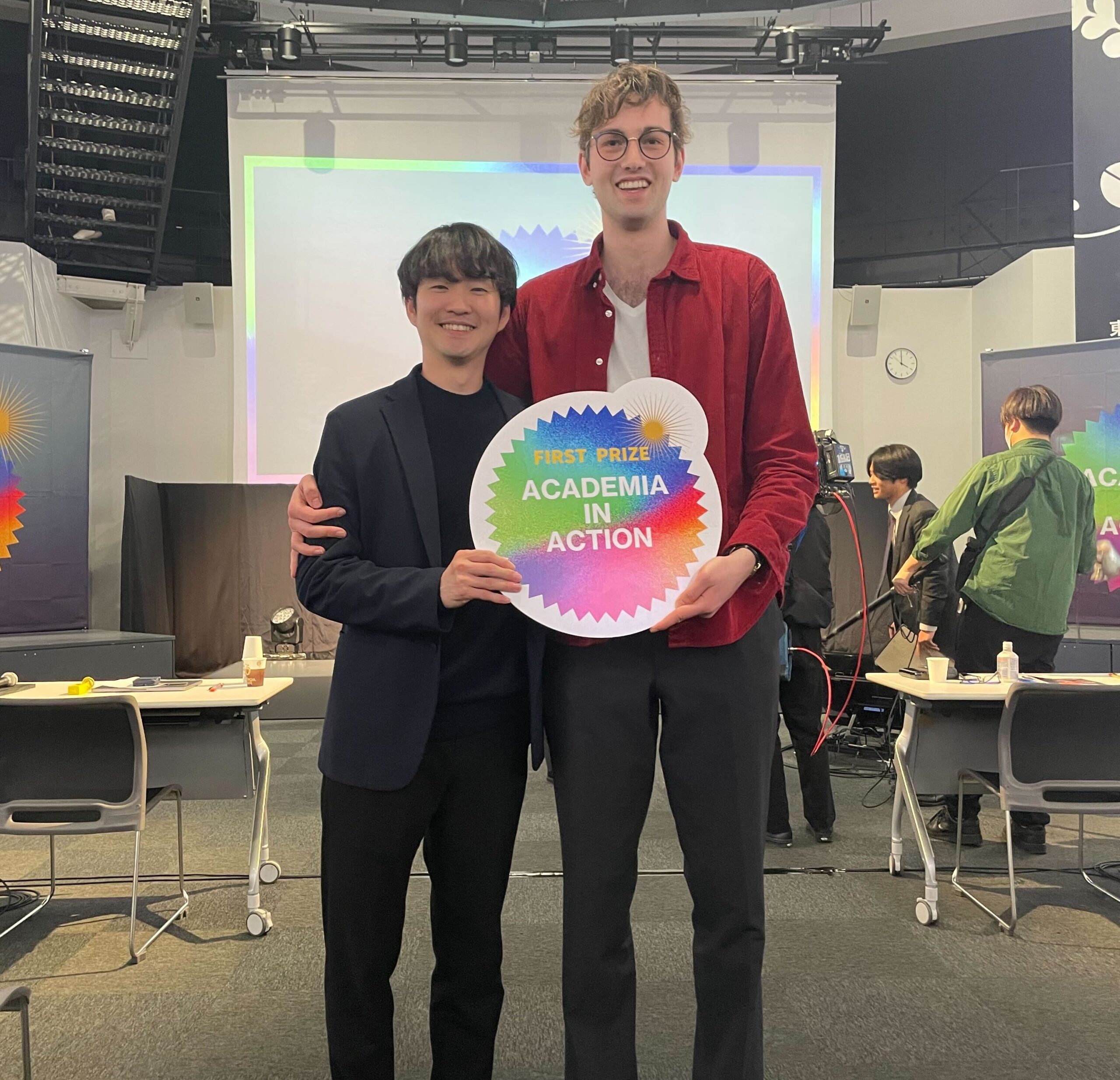
They are participating in “Social Impact Booster” (hosted by City of Sendai) and the “MiTohoku” program (hosted by the Ministry of Economy, Trade and Industry), and are receiving funding from the Miyagi Industrial Promotion Organization. They have also received practical support from both Sendai City Startup Support Division as well as Tohoku University Startup Garage during company registration. “Japan’s paperwork can be complex,” Hans admits. “But in Sendai, we have received so much support, so it’s manageable to register a company even as foreigners.”
Vision for the Future
In the next three to five years, RexTec aims to establish RexCheck in schools across Japan, expand collaborations with hospitals and researchers, build AI-enabled early-intervention and prevention tools, create a globally scalable model based on their Sendai-developed approach, and reduce stigma and awareness gaps around gaming disorder. Hans adds: “I want technology to accelerate society again not decelerate, and I want Japan to be the forefront of where we solve these issues.”
Message to Future Founders
Kendal encourages new founders to focus deeply on the problem, not the solution. “If you’re considering Japan, seriously consider Sendai. The support ecosystem here is exceptional, especially for mission-driven companies.” Hans adds a personal note, “Don’t let self-doubt win. If Japan excites you, take the step. Life becomes more meaningful when you work on what you truly care about.”
Their journey shows that impactful innovation does not require building in the world’s largest cities. Sometimes, the most meaningful work begins in communities that value resilience, connection, and long-term vision. In Sendai, Kendal and Hans found an exact place where technology and humanity can move forward together.